




Table of Contents
- Understanding Proportions in Streetwear
- How to Style Oversized Hoodies Without Looking Shapeless
- Choosing the Right Bottoms for Visual Balance
- Streetwear Outfit Formulas That Actually Work
- Layering Techniques for Streetwear Depth
- Body Type Considerations for Proportional Balance
- Common Mistakes That Throw Off Your Proportions
- Frequently Asked Questions
Last Updated: October 2, 2026
Understanding Proportions in Streetwear
Understanding how to balance proportions in streetwear starts with one core principle: visual equilibrium. When one part of your outfit is voluminous, another must be fitted. When your top is boxy, your bottoms should taper. This isn't just fashion theory; it's visual math.
Divide your body into thirds: head/neck, torso, and legs. Each needs balanced visual weight. An oversized hoodie with baggy cargo pants collapses into one shapeless mass, leaving the eye with nowhere to land.

What the Rule of Thirds Means for Your Fit
Divide your outfit into three visual zones: one gets volume, the other two stay structured. This contrast makes streetwear look intentional rather than sloppy.
If your top is voluminous, your bottoms must be tapered or fitted. If your bottoms have volume, your top should be structured or cropped.
Silhouette as Your Foundation
Your silhouette is the outline your clothes create, what someone sees from across the room. A strong silhouette has clear edges.
The fix: always have at least one fitted element. Fitted jeans with an oversized hoodie. Tapered cargo pants with a boxy t-shirt.
How to Style Oversized Hoodies Without Looking Shapeless
Oversized hoodies are a streetwear staple, but they're also the easiest way to look shapeless if paired incorrectly. The solution: contrast at the bottom.
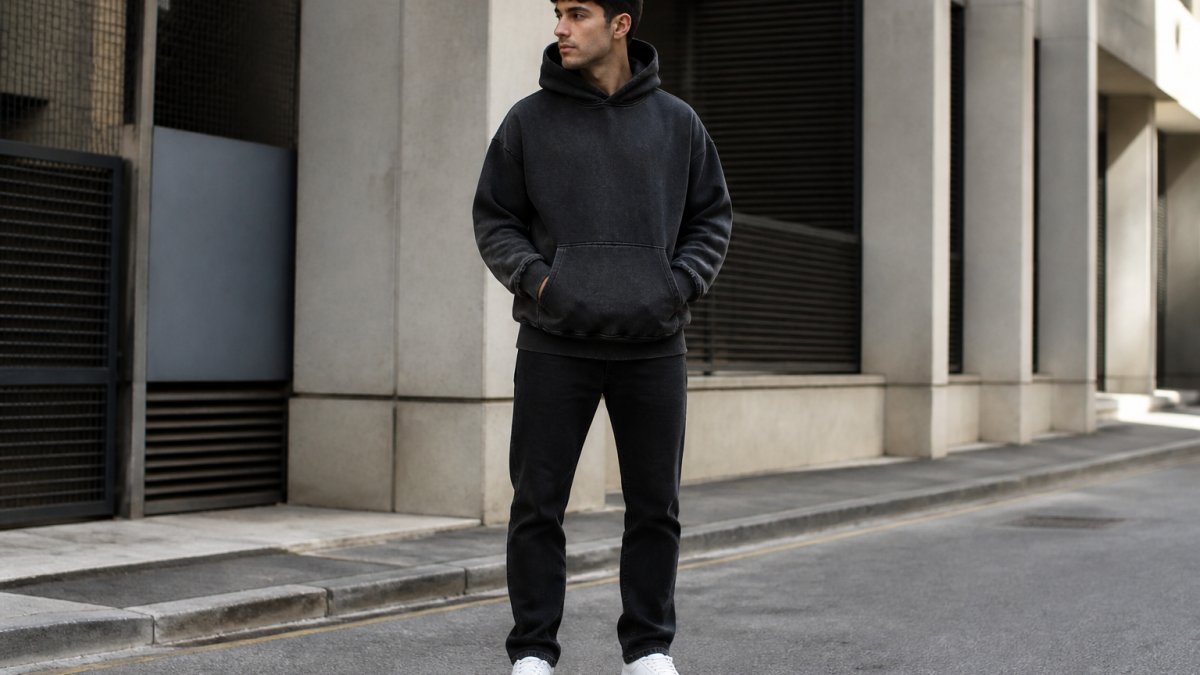
Pairing with Tapered or Fitted Bottoms
An oversized hoodie demands tapered bottoms. Tapered means the leg gradually narrows from hip to ankle; skinny is tight throughout.
Pair your oversized top with:
- Tapered black jeans (relaxed fit at the hip, narrow at the ankle)
- Cropped trousers that hit at your ankle bone
- Fitted joggers with a tight cuff
- Chinos in a structured fabric
The contrast between a loose top and fitted bottom creates visual balance. Your eye stops at the ankle, indicating intentional design.
Length and Drop Shoulder Considerations
Drop shoulders extend past your natural shoulder point, creating extra fabric around the arms and chest, amplifying the oversized effect.
For drop-shoulder hoodies, keep bottoms tight: snug through the thigh, cuffs at the ankle bone, and a straight leg only.
The Cali Studios Heavy Hoodie comes in a boxy, drop-shouldered fit that runs oversized. Pair it with tapered bottoms to create definition. The contrast between the voluminous shoulders and fitted legs is what makes the look work.

Choosing the Right Bottoms for Visual Balance
Your bottoms anchor any streetwear outfit, determining whether your top looks intentionally oversized or accidentally sloppy.
Wide-Leg vs. Tapered: When to Use Each
Tapered bottoms work with voluminous tops, creating contrast and defining the silhouette. Wide-leg bottoms work with fitted or cropped tops, shifting volume to your legs. Never combine volume on top with volume on bottom; one area gets volume, everything else gets structure.
Fabric Weight and Drape Impact
Fabric weight matters significantly. Heavy fabric drapes differently than light fabric; a lightweight hoodie clings, while a heavy one hangs away from your body.
Heavier fabrics create defined silhouettes, hide body shape, and require less fitted bottoms to balance.
The Cali Studios Heavy Hoodie uses a 500GSM cotton-poly blend with brushed inner fleece. That weight means the hoodie holds its shape.
Streetwear Outfit Formulas That Actually Work
Streetwear outfits that look sharp follow patterns. Learn these formulas and build dozens of outfits from a small wardrobe.
The Oversized Top + Fitted Bottom Formula
Start with an oversized hoodie or t-shirt, add tapered or fitted jeans, layer with a structured jacket if needed, and finish with clean trainers. Example: Oversized hoodie + tapered black jeans + white trainers creates a balanced look with clear silhouette edges.
The Balanced Volume Formula
Wear a fitted or cropped top, add wide-leg or cargo bottoms, layer with an oversized overshirt or jacket, and keep footwear clean and minimal. Example: Cropped Flame T-shirt + Saint Cargo Pants in washed olive + clean trainers balances a fitted top with voluminous bottoms.
Layering Techniques for Streetwear Depth
Good layering creates dimension; bad layering creates bulk.
Base Layer, Mid-Layer, Outerwear Structure
Think of layering in three zones:
Base layer: Fitted or cropped t-shirt. Mid-layer: Statement piece (oversized hoodie, unbuttoned shirt, lightweight jacket) where you add volume and texture. Outerwear: Structured jacket, bomber, or coat that defines silhouette. Each layer should be progressively looser than the one underneath, creating clear visual separation.
Creating Visual Interest Through Texture Contrast
Pair different fabrics for texture contrast: a smooth cotton hoodie over a textured knit, oversized linen over a fitted tee, a structured denim jacket over soft fleece. Texture contrast makes streetwear look curated rather than thrown together.
Body Type Considerations for Proportional Balance
Proportions aren't one-size-fits-all. Your height, shoulder width, and frame shape fundamentally change which silhouettes work and how to scale volume. Rather than generic advice, the key is understanding how to progress from fitted to oversized as your frame grows, and how to use proportional ratios to stay visually balanced regardless of your build.
Proportions for Shorter Frames (Under 5'7")
Shorter frames face a specific challenge: oversized pieces designed for average heights will overwhelm you. The volume-to-frame ratio becomes disproportionate.
The progression approach:
- Beginner stage: Start with a fitted or semi-fitted hoodie (not oversized). Pair with tapered jeans that hit at your ankle bone. This establishes your baseline silhouette.
- Intermediate stage: Move to a moderately oversized hoodie (one size up, not two). Ensure it hits at your hip, never past mid-thigh. Pair with cropped or high-waisted tapered bottoms. The cropped length prevents the outfit from swallowing your frame.
- Advanced stage: Wear fully oversized pieces, but use strategic layering and cropping. An oversized hoodie over a fitted long-sleeve tee, paired with tapered jeans that sit high on the hip and hit at your ankle bone. The layering adds visual breaks that prevent shapelessness.
Specific measurements to follow:
- Hoodie length: should hit between your hip and mid-thigh (not lower)
- Jeans rise: high-waisted (approximately 25-28 cm) to elongate your legs
- Jeans inseam: should hit at your ankle bone with minimal stacking
- Drop shoulders: avoid extreme drop-shoulder pieces; standard shoulder seams work better
- Trainer size: keep proportional to your frame; oversized trainers will anchor you down visually
Fabric weight matters more for shorter frames. A lightweight hoodie will cling and look fitted even when oversized. A heavyweight hoodie (500GSM+) will hang away from your body and create actual volume.
Proportions for Average Frames (5'7" to 5'11")
Average frames have the most flexibility. You can wear true oversized pieces without them overwhelming you, and you can also wear fitted silhouettes without looking cramped.
The balanced formula:
- Oversized hoodie can hit mid-thigh
- Tapered jeans with standard rise (approximately 23-25 cm) work well
- Drop-shoulder pieces sit naturally on your shoulders
- Standard trainer sizes feel proportional
This is the "reference frame" most styling guides use. If you're in this range, most streetwear advice applies directly.
Proportions for Taller Frames (Over 5'11")
Taller frames have the opposite problem: standard oversized pieces often don't feel oversized enough. They can look fitted on you.
The progression approach:
- Beginner stage: Wear standard oversized hoodies with relaxed (not tapered) jeans. The relaxed fit at the hip and thigh creates volume without looking tight. Pair with standard trainers.
- Intermediate stage: Move to drop-shoulder hoodies that actually drop (not just standard oversized). Pair with wide-leg or cargo bottoms. The volume scales to your frame size.
- Advanced stage: Layer oversized pieces over fitted bases. An oversized hoodie over a fitted long-sleeve tee, paired with relaxed or wide-leg bottoms. The layering adds depth without requiring extreme proportions.
Specific measurements to follow:
- Hoodie length: can hit mid-thigh or lower without overwhelming you
- Jeans rise: standard (approximately 23-25 cm) or relaxed (approximately 25-28 cm)
- Jeans inseam: should hit at your ankle bone; avoid cropping, which can make you look even taller
- Drop shoulders: embrace them; they sit properly on broader shoulders
- Trainer size: larger trainers (UK 10-12+) feel proportional to your frame
Fabric weight works differently for taller frames. A lightweight hoodie will look fitted on you. A heavyweight hoodie (500GSM+) will drape properly and feel genuinely oversized.
The Rule of Thirds Applied to Your Frame
Regardless of height, use the Rule of Thirds to check your proportions:
- Top third (head to mid-chest): This should feel proportional to your frame. If your hoodie's shoulders extend far past your natural shoulders, it's too voluminous for your build.
- Middle third (mid-chest to hip): This is where most volume sits. For shorter frames, keep this tighter. For taller frames, you can expand it.
- Bottom third (hip to ankle): This anchors your silhouette. For shorter frames, keep this fitted. For taller frames, you can relax it.
When all three thirds feel visually balanced relative to your actual frame size, your proportions are working. If one section overwhelms the others, adjust fabric weight, length, or fit.
Common Mistakes That Throw Off Your Proportions
Most people make the same three mistakes. Knowing them means you won't.
Going All Oversized at Once
This is the biggest error. An oversized hoodie plus oversized jeans plus an oversized jacket equals a shapeless blob. There's no contrast. Your silhouette disappears.
The fix: one oversized piece per outfit. Everything else stays fitted or structured. That one piece becomes the statement. The rest supports it.
Ignoring Footwear Scale
Your trainers matter more than most people realise. They're the visual anchor at the bottom of your outfit.
Oversized outfits need clean, minimal trainers. Chunky or oversized trainers add more volume. They throw off your proportions at the bottom. Keep trainers simple: white leather, black leather, or neutral canvas.
Mismatched Fabric Weights
Pairing a heavy hoodie with lightweight, flimsy jeans creates visual confusion.
Always match fabric weight:
- Heavy hoodie + structured, heavyweight jeans
- Lightweight tee + lighter-weight trousers
- Textured cargo pants + substantial top
When fabrics match in weight, proportions feel intentional.
Last Updated: October 2, 2026
At Cali Studios, we design pieces that fit into this system. The Heavy Hoodie in washed black works because it's substantial enough to anchor an outfit. Pair it with the Saint Denim Jeans in a relaxed fit, and you've got immediate contrast. The hoodie is voluminous. The jeans are tapered. Your silhouette has definition.

Start with one quality oversized piece. Build around it with fitted bottoms and clean trainers.
Get started with Cali Studios and build outfits that actually balance.
Frequently Asked Questions
How do you balance oversized clothes in a streetwear outfit?
The key is pairing oversized pieces with fitted or tapered bottoms. If your top is voluminous, keep your jeans or cargo pants slim through the leg. Use the Rule of Thirds: divide your outfit into thirds vertically. One third should be fitted, one third oversized, and one third neutral. Fabric weight matters too; heavier materials hold their shape better and create cleaner silhouettes than lightweight fabrics that drape too much.
Should streetwear always be baggy?
No. Intentional streetwear balances volume with structure. A baggy hoodie paired with baggy cargo pants creates shapelessness rather than style. The most effective streetwear outfits use contrast: oversized outerwear with fitted base layers, or relaxed fits with structured pieces. This approach maintains the streetwear aesthetic while keeping your silhouette intentional and visually interesting.
What's the difference between oversized and just poorly fitted?
Oversized clothing has intentional design, drop shoulders, boxy cuts, and specific proportions built in. Poorly fitted pieces hang unevenly or bunch awkwardly. When choosing oversized pieces like the Heavy Hoodie from Cali Studios, check how it sits on your shoulders and whether the length complements your height. A proper oversized fit should feel intentional, not accidental.
How do layering techniques improve streetwear proportions?
Layering creates visual depth and breaks up large volumes of fabric. A structured base layer under an oversized hoodie defines your silhouette. Adding a contrasting mid-layer like a cropped t-shirt creates horizontal lines that interrupt vertical bulk. Different fabric textures, smooth cotton, brushed fleece, crisp denim, add visual interest and make outfits feel more composed rather than simply baggy.
