




Last Updated: November 4, 2026
Quick Summary
Reinforced knees are a second layer of fabric sewn over the knee area that slows down abrasion, keeping your trousers intact for longer when you slide, kneel and bail. They protect the garment from friction and knee holes, but they do not cushion impact or protect your joints the way a pad does.
- Blown-out knees usually start over the kneecap and at the seam where fabric meets the side panel.
- Wash inside out on a cool cycle and rotate two pairs to slow fabric breakdown.
- Heavier cotton holds up better against grip tape friction than thin, lightweight denim.
- A panel running from just above the kneecap to a few centimetres below covers the wear zone.
- Sizing down pre-stresses the knee panel and speeds up wear at the crease.
Table of Contents
- What Reinforced Knees Actually Do (and What They Don't)
- How to Prevent Holes in Pants: Where Blowouts Really Start
- The Best Fabric for Skate Pants: Weight, Layers and Stitching
- Why Durable Skate Pants Outlast Standard Denim
- Skateboarding Knee Protection: Pads, Pockets and Reinforced Fabric
- Comfort, Fit and Mobility: The Trade-Offs That Matter
- Choosing Skate Pants That Fit Your Style and Setup
- Frequently Asked Questions
What Reinforced Knees Actually Do (and What They Don't)
Reinforced knees are a second layer of fabric sewn over the knee area of a pair of trousers, and they exist to slow down abrasion, not to cushion impact. We want to be straight about what the benefits of reinforced knees in skate pants really are: they keep your trousers intact for longer when you slide, kneel and bail, but they will not protect your joints the way a pad does.
Double-Knee Construction Explained
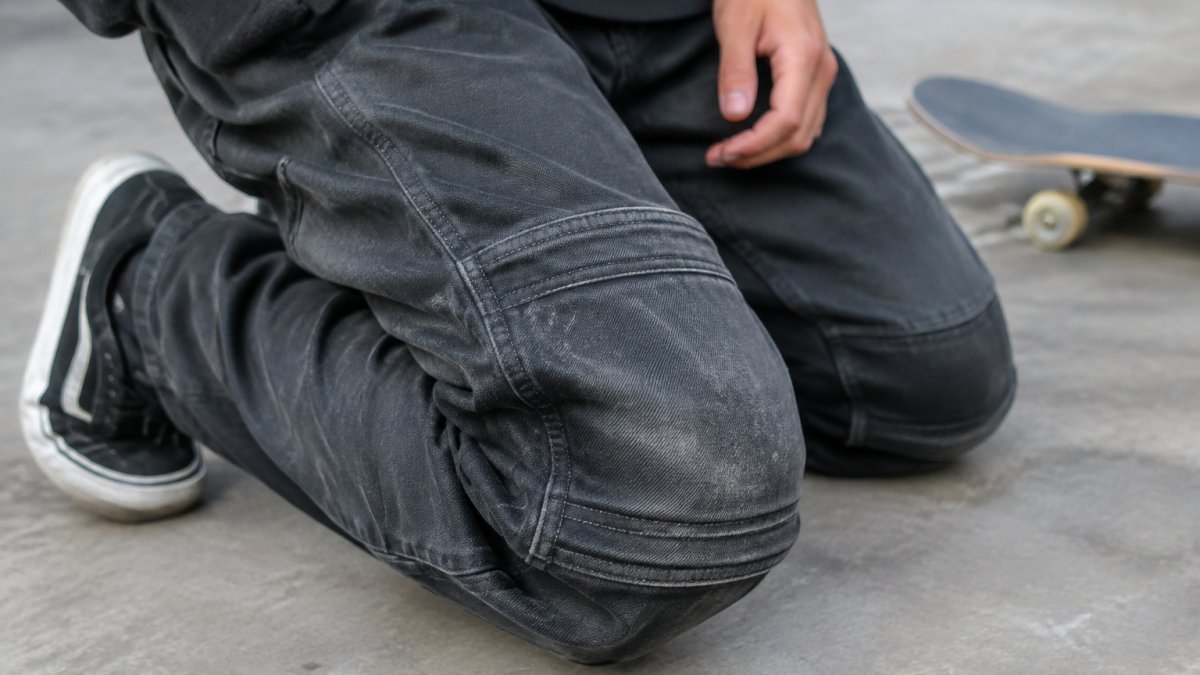
Double-knee construction is exactly what it sounds like: a patch of reinforcement fabric, usually a heavier weave than the base fabric, is stitched over the front of each knee from just above the kneecap to a few centimetres below it. The patch sits flat when you stand and folds with the joint when you bend.
Abrasion Protection vs Injury Prevention
This is where a lot of guides blur the line. Abrasion protection is about the garment: reinforced knees resist friction from grip tape, concrete and repeated kneeling, which is what stops knee holes forming. Injury prevention is about your body, and that is the job of a separate knee pad or a built-in pad. Reinforced fabric will not absorb a hard fall onto the kneecap, and it will not stop joint strain. Treat it as protective clothing for the trousers, not for you.
How to Prevent Holes in Pants: Where Blowouts Really Start
Blown-out knees almost always start at the same two points: the highest-stress spot directly over the kneecap, and the seam where the fabric meets the side panel. Both take the brunt of friction when you crouch, push and slide.
To prevent holes in pants, work through these steps:
- Buy trousers with a reinforced or double-layer knee panel rather than a single layer of thin denim.
- Check the stitching at the corners of the knee panel, since loose or single-stitch corners are the first thing to fail.
- Wash inside out on a cool cycle to slow fabric breakdown.
- Repair small scuffs early with a patch or a few stitches before they spread into a tear.
- Rotate two pairs rather than wearing one pair every session, so the fabric has time to recover.
A common mistake is sizing down for a "snug" look. Too-tight knees stretch the fabric across the joint every time you bend, and stretched fabric wears through faster.
The Best Fabric for Skate Pants: Weight, Layers and Stitching
A mid-to-heavy weight cotton or cotton-blend woven tight enough to resist abrasion, with a reinforced second layer at the knee, is a sensible choice for skate pants. Weight matters more than most people think: a heavier fabric simply has more material to wear through before a hole appears.
Look for these construction details:
- Fabric weight: heavier cotton holds up better against grip tape friction than thin, lightweight denim.
- Layers: a double-knee panel gives you two layers of protection where you need it and one layer everywhere else, so you keep breathability.
- Stitching: tight, dense stitching at the knee panel and seams adds seam strength and resists tearing.
- Fit: enough room to bend without the fabric pulling tight across the knee.
For a fuller breakdown of construction and fabric choices, see our guide to durable streetwear for skateboarders.
Why Durable Skate Pants Outlast Standard Denim
If you want to go deeper on the durability side, our piece on durable streetwear joggers for skateboarding covers the details.
Skateboarding Knee Protection: Pads, Pockets and Reinforced Fabric
Skateboarding knee protection comes in three forms, and they do different jobs. Reinforced fabric handles abrasion. Built-in knee pads or separate knee guards handle impact. Knee-pad pockets let you slot a pad in and out depending on the session. Most guides stop there, but the practical question is which one actually suits how you skate, so here is a straight comparison by protection, mobility, comfort, cost, and intended use.
Reinforced fabric (double-knee panel). Protection: abrasion only, it slows wear from grip tape, concrete, and repeated kneeling, but does not absorb impact. Mobility: good if the panel is shaped to the knee and the leg has enough ease; a stiff or poorly cut panel can restrict deep crouches. Comfort: adds a little warmth and stiffness, but no bulk under the knee. Cost: usually built into the trouser price, so no separate purchase. Best for: street and everyday skating where you slide and kneel often but are not taking hard, repeated impacts to the kneecap.
Separate knee guards. Protection: impact and abrasion, a hard cap or dense foam shell spreads force away from the kneecap and protects against sharp edges. Mobility: more restrictive than fabric alone, especially in deep bends, and the straps can shift during pushing. Comfort: bulkier and warmer; some skaters find them sweaty over a long session. Cost: a separate item, often the most expensive option if you buy a reputable pair. Best for: transition, big drops, and any session where hard falls onto the knee are likely.
Knee-pad pockets (built-in pad sleeves). Protection: impact when a pad is inserted, abrasion from the fabric layer when it is not. Mobility: depends on the pad, a slim insert moves well, a thick one less so. Comfort: the pocket adds a layer and can feel warm, but keeps the pad from slipping. Cost: you pay for the trouser plus the pad, but you avoid buying a separate guard. Best for: skaters who want one pair of trousers to cover both everyday abrasion and occasional impact sessions.
A common pattern is that skaters buy reinforced pants first, then add a separate guard for bigger sessions, rather than choosing a pad pocket straight away. That works, but it means carrying two items. If you already know you will pad up regularly, a trouser with a pad pocket can be the more practical single purchase. If you mainly want your trousers to survive, reinforced knees are the simpler choice.
Watch out: a reinforced knee panel is not a substitute for an impact-rated pad, and a pad pocket without a pad offers no impact protection at all, do not assume the pocket alone protects the joint.
Our roundup of durable streetwear for daily skating lists the pieces worth building around.
Comfort, Fit and Mobility: The Trade-Offs That Matter
Reinforced knees trade a little flexibility for a lot of durability. A double-layer panel is stiffer than a single layer, and cheap reinforcement can feel bulky or restrict range of motion when you crouch. The fix is in the cut: a panel that follows the shape of the knee, with enough ease in the leg, bends with you instead of fighting you. But the trade-offs go further than most guides admit, so here is what actually changes when you add a reinforced knee.
Panel shape and placement. A panel cut as a straight rectangle will crease and pull when you bend; a panel shaped with a slight curve or a dart at the knee follows the joint and folds cleanly. Placement matters too, a panel that starts too low or ends too high leaves the highest-stress spot exposed or bunches behind the knee.
Stretch and fabric blend. A rigid cotton panel resists abrasion well but can feel stiff on the first few wears; a small amount of stretch in the base fabric (a cotton-elastane blend, for example) lets the leg move without the panel pulling tight. Too much stretch, though, and the fabric wears through faster because it thins under tension. The balance is a mid-to-heavy woven with just enough give to crouch comfortably.
Cut and ease through the leg. A relaxed or straight leg gives the fabric room to bend without stretching across the knee. A slim cut looks sharper but puts more tension on the panel every time you crouch, which speeds up wear at the crease. If you size down for a snug look, you are effectively pre-stressing the knee panel before you even skate.
Ventilation and heat. A second layer traps heat, and heavy fabric with no airflow gets hot fast, especially in summer or during long sessions. Look for a panel that covers only the knee rather than wrapping the whole leg, and consider a lighter base fabric if you run hot. Breathability is a real trade-off against abrasion resistance, you cannot max both.
Board feel and pushing. A bulky panel or a thick pad pocket can dull board feel under the knee and make repeated pushing feel less direct. Slimmer panels and pads preserve more feel; heavier protection costs some connection to the board. Decide which matters more for your skating before you buy.
When you try a pair, bend deeply and check three things: does the panel crease comfortably, does the fabric pull tight across the front of the knee, and does the waist stay put. Then crouch and push a few times, if the panel bunches behind the knee or the leg twists, the cut is wrong for you. For more on balancing comfort with daily wear, read our guide to comfortable streetwear for daily skate sessions.
Choosing Skate Pants That Fit Your Style and Setup
Match the trouser to how you actually skate. Street skaters who slide and kneel a lot get the most from a reinforced knee. Park skaters who mostly stay upright can prioritise fit and breathability. If you wear a pad, look for a roomier leg so the pad sits cleanly underneath.
Our relaxed-fit denim jeans are cut with room through the leg and a right-knee rip, priced at £100.00.
| Skating style | Priority | Best pick |
|---|---|---|
| Street, lots of sliding | Abrasion resistance | Reinforced knee panel |
| Park, mostly upright | Fit and breathability | Mid-weight single layer |
| Big sessions, hard falls | Impact protection | Pad pocket or separate guard |
| Everyday wear | Comfort and style | Relaxed-fit durable denim |
Frequently Asked Questions
Do reinforced knees make skate pants last longer?
A double-knee panel sits where friction and repeated contact wear fabric thin first, which is why reinforced knees are designed to resist abrasion at that point.
Do reinforced knees protect your knees when skateboarding?
They protect the fabric, not your joints. Reinforcement improves abrasion resistance against grip tape, concrete and repeated kneeling, but it does not absorb impact. For actual skateboarding knee protection against falls, you need separate knee guards or pants with built-in knee pads or knee-pad pockets. Think of reinforced knees as durability, and pads as impact protection. They solve different problems and work best together.
Are work trousers with knee reinforcement suitable for skating?
They can work, but check the cut first. Workwear reinforcement is often built for kneeling on site, so the fabric can be stiff and the fit boxy, which limits range of motion on a board. Look for reinforcement fabric that moves with you, a gusseted or articulated knee, and a fit that does not bunch. If the trousers feel restrictive when you crouch, they will feel worse mid-session.
How should I care for skate pants with reinforced knees?
Wash them inside out on a cool cycle and skip the tumble dryer, because heat weakens stitching and shrinks cotton. Avoid fabric softener, which coats fibres and reduces breathability. Check the reinforcement stitching every few weeks and repair loose seams early, before a small fray becomes a blown-out knee. Rotating two pairs gives each one time to dry and roughly doubles the lifespan of both.
The real test is whether your trousers survive a full season of skating without the knees giving out. At Cali Studios, we build durable streetwear with comfortable fabrics in oversized and regular fits, so you get statement pieces that hold up to daily wear. Start with a pair of reinforced skate pants and see the difference for yourself.

