




Table of Contents
- Durable Streetwear T-Shirts vs Fast Fashion: What's the Difference?
- Why Cheap Tees Fall Apart: The Fast Fashion Problem
- How to Spot High-Quality T-Shirts: Fabric and Construction
- Cost Per Wear Calculation: The Number That Decides It
- Streetwear Tees That Hold Up: Cali Studios Range
- Sustainable Streetwear Brands vs Mass Production
- Repair and Upcycling: Extend Your Tee's Life
- Conclusion: Where to Put Your Money
- Frequently Asked Questions
Last Updated: September 7, 2026
Durable Streetwear T-Shirts vs Fast Fashion: What's the Difference?
The debate between durable streetwear t-shirts vs fast fashion alternatives comes down to one question: are you buying a product or a problem? A £10 tee feels like a bargain until it pills, loses its shape, and ends up in landfill within a season. At Cali Studios, we design for the streetwear scene. This guide breaks down the technical differences, the cost-per-wear math, and why heavyweight cotton changes your wardrobe.
The core distinction is manufacturing philosophy. Fast fashion relies on mass production with thin fabrics and loose construction to keep prices low. Durable streetwear t-shirts use heavier materials, denser stitching, and timeless design to survive years of daily wear. The environmental footprint of that cheap tee is also far heavier than most shoppers realise, a factor the Ellen MacArthur Foundation's circular fashion research has highlighted in its work on textile waste.
Why Cheap Tees Fall Apart: The Fast Fashion Problem
The GSM Threshold: Why 150 GSM Fails
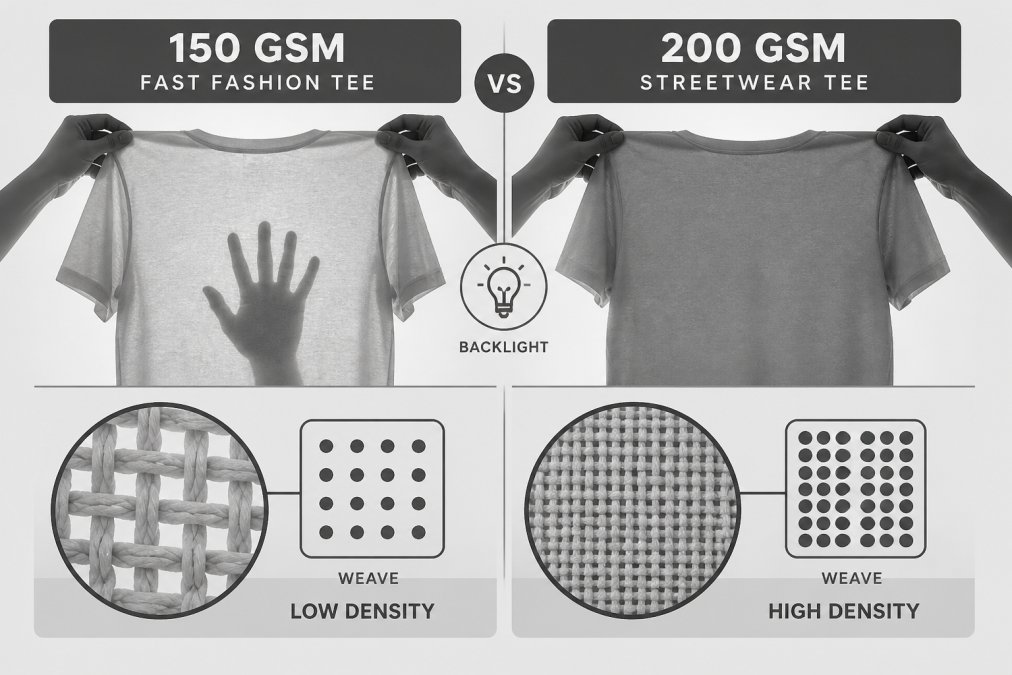
GSM (grams per square metre) is the most cited durability metric, but the mechanism is rarely explained. A 120-150 GSM tee uses a single layer of open-weave cotton. Under tension, the yarns shift and the fabric thins at stress points, shoulders, elbows, and the collar. This is why a cheap tee becomes translucent after a few washes: the fabric structure itself relaxes and loses density.
A 200 GSM tee, by contrast, uses a tighter, heavier weave. The yarns are packed closer together, which means more friction between fibres. That friction is what resists pilling and prevents the fabric from bagging out at the elbows. The difference isn't just feel, it's structural integrity.
Stitch Density: The Hidden Failure Point
Fast fashion tees typically use 4-6 stitches per inch on side seams, a cost-saving measure. Low stitch density creates weak points where the seam can split under tension. Quality streetwear tees use 8-10 stitches per inch, often with a double-needle hem. That's the difference between a seam that holds for 100 washes and one that pops after a season.
The Collar: A Case Study in Planned Obsolescence
The collar is the first thing to fail on a cheap tee. Fast fashion collars use a thin, single-layer ribbed knit that's heat-set into shape; once that bond breaks down in the wash, the collar stretches permanently. A quality streetwear tee uses a thicker, denser ribbed collar sewn in with reinforcing tape, designed to snap back, not sag. If a collar doesn't return to shape within seconds, it won't survive the year.
Print Failure: Not All Graphics Are Equal
Print cracking is another predictable failure. Fast fashion uses plastisol ink in a thick layer on top of the fabric; when the tee stretches, the ink can't, so it cracks. Durable streetwear tees often use water-based inks or screen-printed layers that bond with the fibres, becoming part of the fabric. That's why a £50 graphic tee looks sharp after 50 washes while a £15 one looks like a relic after ten.
The Real Cost of 'Cheap'
A £15 tee that fails at the collar, splits at the seam, and fades after 15 washes isn't just a bad deal, it's a predictable outcome of the manufacturing process. The fix isn't to buy more cheap tees; it's to buy one engineered to last.
How to Spot High-Quality T-Shirts: Fabric and Construction
Learning how to spot high-quality t-shirts saves you money every time you shop. You don't need to be a fabric expert, just check the weight of the cotton and the stitching.
Fabric Weight and GSM Explained
GSM stands for grams per square metre, and it's the single best indicator of durability. Look for 180 GSM and above for a solid everyday tee, with 200 GSM the sweet spot for streetwear that holds its shape. Anything below 150 GSM is likely flimsy. Heavyweight cotton is also more opaque, so you won't get that see-through effect under bright light.
Stitch Density and Seam Quality
Flip the tee inside out and look at the seams. A durable tee should have tight, consistent stitching, roughly 8-10 stitches per inch, with reinforced shoulder seams and a ribbed collar that snaps back. Loose threads, uneven seams, and a flimsy collar are red flags that the tee won't survive its first year.
Cost Per Wear Calculation: The Number That Decides It
The cost per wear calculation is the most honest way to compare a premium tee against a disposable one. Divide the purchase price by the number of times you wear it before it dies.
A £15 fast fashion tee might last 10 wears before the collar stretches and the print fades, giving a cost per wear of £1.50. A £50 heavyweight tee from Cali Studios, worn once a week for two years, easily hits 100 wears, £0.50 per wear, a third of the cost of the "cheap" option.
The table below summarises the typical comparison:
| Option | Price | Estimated Lifespan | Cost Per Wear |
|---|---|---|---|
| Fast fashion tee | £15 | 10-15 washes | ~£1.00 - £1.50 |
| Mid-range tee | £30 | 30-50 washes | ~£0.60 - £1.00 |
| Heavyweight streetwear tee | £50 | 100+ washes | ~£0.50 or less |
Streetwear Tees That Hold Up: Cali Studios Range
Cali Studios offers durable streetwear t-shirts, built around heavyweight 200 GSM cotton.
The Skull T-shirt - Black and Saint Tour T-shirt - Black are the core heavyweights at £50. Both feature a round neck, front graphic print, and short sleeves, with the 200 GSM cotton providing the structure that fast fashion tees lack. The fit is designed to work for the streetwear aesthetic, with the model at 5ft 10 wearing a size large for that relaxed look.


If you want the distressed look without paying top dollar, the Eagle T-shirt at £40 and the Burnt Out T-shirt at £35 offer a hand-distressed, faded black finish with a boxy fit. These are pre-distressed, so the worn-in aesthetic is intentional, but the base fabric still holds up to repeated washing. For a budget entry point, the Tiger T-shirt at £22 is a cropped option with a raw edge hem, though the lighter construction means it suits fashion-forward layering more than heavy daily abuse.

Sustainable Streetwear Brands vs Mass Production
Repair and Upcycling: Extend Your Tee's Life
Generic repair advice, 'sew a seam, patch a hole', doesn't address the specific ways streetwear t-shirts fail. Heavyweight tees have different failure points than fast fashion ones, and the repairs are different too. Here's how to handle the three most common issues with a 200 GSM tee.
Fixing Collar Stretch on Heavyweight Tees
A heavyweight collar doesn't stretch the way a thin fast fashion collar does. Instead of the ribbing relaxing, the seam where the collar meets the body often pulls, creating a wavy, distorted neckline. The fix is a technique called 'collar reset':
- Turn the tee inside out.
- Run a steam iron over the collar seam to relax the fibres.
- Pin the collar flat against the body, matching the original seam line.
- Sew a reinforcing stitch along the existing seam, using a stretch needle and polyester thread (cotton thread will break under tension).
- Press again and let it cool completely before wearing.
This works because heavyweight cotton responds to heat and steam better than the synthetic blends used in fast fashion, the fibres reset rather than melt or distort.
Repairing Print Cracks Without Ruining the Graphic
Print cracking on a streetwear tee is different from a fast fashion failure. On a quality tee, the print is bonded into the fibres, so cracks are usually surface-level. You can often revive it:
- Place a piece of baking paper over the cracked area.
- Run a warm iron over it for 10-15 seconds (no steam).
- The heat re-activates the ink slightly, smoothing out minor cracks.
For deeper cracks where the print is lifting, use a fabric glue applied with a toothpick under the lifted edge, then press flat with a heavy book for an hour. This won't make it perfect, but it will stop the crack from spreading and peeling further.
Visible Mending for Streetwear Aesthetics
Visible mending isn't just about fixing, it's a design choice that fits the streetwear ethos of customisation. For a tear or burn hole on a heavyweight tee:
- Trim any loose threads around the hole.
- Choose a contrasting thread colour (white on black, or a bright accent) and a darning needle.
- Weave horizontal stitches across the hole, then vertical stitches over them, creating a woven patch.
- For extra structure, place a small piece of fusible interfacing behind the hole before you start.
The result is a deliberate, rugged look that adds character rather than hiding damage. This works on 200 GSM fabric because the dense weave holds the repair stitches securely; on a thin fast fashion tee, the surrounding fabric would tear again within a few wears.
Upcycling: When Repair Isn't Worth It
There comes a point when a tee is beyond repair, after 10-15 washes for a fast fashion tee, or after 100+ wears for a heavyweight streetwear tee. When that time comes, don't throw it in the bin:
- Cut the body into cleaning rags, heavyweight cotton is excellent for dusting and polishing.
- Remove the sleeves and hem for a sleeveless gym top.
- Cut the graphic panel out and sew it onto a hoodie or jacket as a patch.
- Use the fabric as a backing for other mending projects.
The UK Textile Recycling Reality
When a tee is truly at the end of its life, textile recycling is more accessible than most people think. Major retailers operate in-store collection bins, and many local councils offer kerbside textile collection. Check whether your local scheme accepts all fabric types; some only take clean, undamaged items. For worn-out tees, look for 'textile-to-textile' recycling schemes rather than charity shops, which often send damaged goods to landfill anyway.
Conclusion: Where to Put Your Money
The choice between durable streetwear t-shirts vs fast fashion alternatives stops being a trade-off once you run the cost-per-wear numbers. A heavyweight tee from Cali Studios can offer lasting quality.
If you're tired of replacing faded, misshapen tees every few months, it's time to upgrade your wardrobe staples. Cali Studios builds its range around comfortable 200 GSM cotton, available in oversized and regular fits, with designs that work for the street and the skate scene. Add a heavyweight tee to your rotation and see the difference for yourself.
Frequently Asked Questions
What are the main differences between durable streetwear and fast fashion?
Durable streetwear t-shirts use heavier cotton (200gsm or more), tighter stitching, and better construction methods. Fast fashion tees typically use thin fabrics around 120-150gsm with loose stitching that fails after a few washes. The result: durable streetwear t-shirts keep their shape and graphics for years, while fast fashion alternatives fade, stretch, and tear within months.
How does fabric weight impact the durability of a t-shirt?
Fabric weight, measured in GSM (grams per square metre), directly correlates with durability. A 200gsm cotton t-shirt is roughly 40% heavier than a standard fast fashion tee at 140gsm. That extra density means the fabric resists stretching, holds its structure through repeated washing, and provides a better drape for an oversized fit. Heavyweight cotton also blocks more light, so it doesn't become see-through after washing.
How do I calculate cost per wear for streetwear t-shirts?
Divide the price by the number of times you expect to wear it. A £50 durable streetwear t-shirt worn 100 times costs 50p per wear. A £15 fast fashion tee worn 10 times before it loses shape costs £1.50 per wear. Track your actual wear count: most people wash and rotate t-shirts weekly, so a durable tee lasts 2-3 years while a cheap one survives 2-3 months.
Are there affordable ways to build a sustainable streetwear wardrobe?
Yes. Start with a capsule wardrobe of 5-7 heavyweight t-shirts in neutral colours you can rotate daily. Buy from streetwear brands that use 200gsm+ cotton. When you need variety, shop pre-loved and thrifted pieces to extend garment longevity. Focus on timeless design rather than trend pieces that date quickly, and you will spend less over two years than replacing cheap tees every season.
