




Table of Contents
- Why Standard Sizing Fails Tall Frames
- How to Measure for Oversized Hoodies and Streetwear
- Standard vs Tall Sizing: Understanding the Difference
- Best Streetwear Brands for Tall Men
- Preventing Shrinkage in Cotton Streetwear
- Avoiding the Boxy Fit Trap
- Layering Techniques for Height and Proportion
- Conclusion
Last Updated: August 19, 2026
Why Standard Sizing Fails Tall Frames
Standard sizing is built for an average frame around 178cm to 180cm. For tall guys, this means inseams pull up, torsos hit at the hips instead of the waist, and sleeves end halfway down forearms. The problem isn't that tall-specific clothing doesn't exist, it's that streetwear's oversized silhouette can work brilliantly or completely swallow your frame depending on how you approach it.
Cali Studios recognises this challenge by offering both oversized and regular fits, so you're not forced into one aesthetic. But choosing the right size still requires understanding your actual measurements, not guessing based on what you normally wear. Streetwear sizing charts often don't account for proportional differences between standard and tall frames. A size large in standard sizing might have an inseam of 71cm, while a size large in tall sizing might have an inseam of 81cm. Without knowing your specific measurements, you'll keep ordering pieces that don't fit properly.
How to Measure for Oversized Hoodies and Streetwear
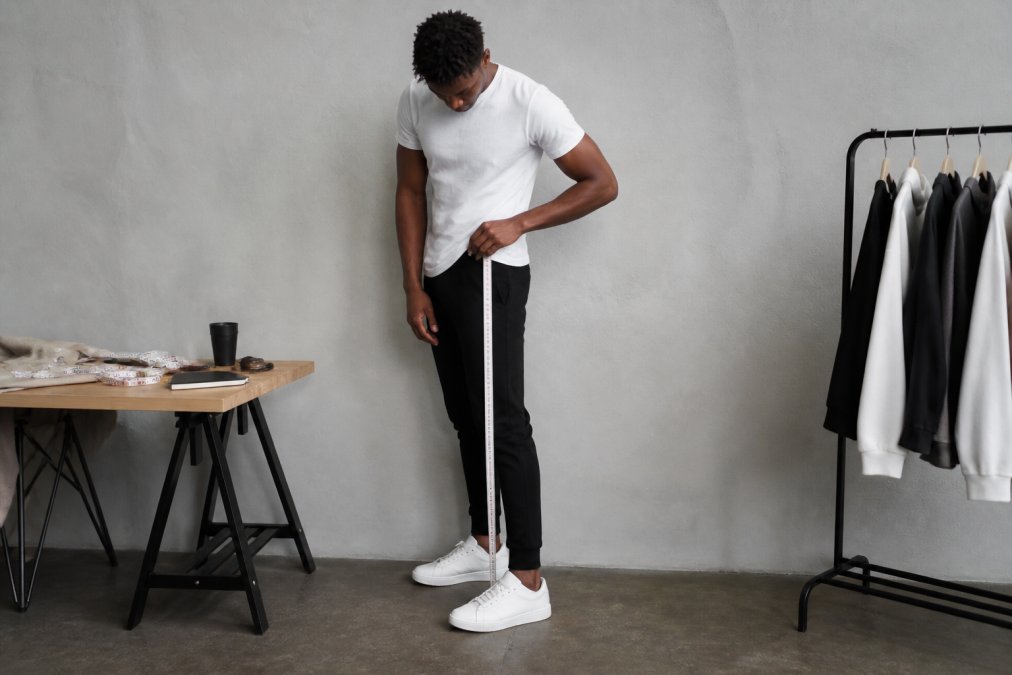
Measuring correctly is the foundation of getting streetwear sizing right for tall guys. You need four key measurements: inseam, torso length, sleeve length, and shoulder width.
Inseam and Torso Length
Your inseam is the distance from your inner thigh to your ankle, the single most important measurement for joggers and tapered trousers. Stand barefoot with your feet shoulder-width apart and have someone measure from your groin down to the top of your ankle bone.
Torso length is equally critical but often overlooked. This is the distance from your shoulder to your hip. A long torso means hoodies and t-shirts need extra length to avoid exposing your midriff when you move. Measure from the top of your shoulder down to where your hip bone protrudes. Many tall guys have proportionally longer torsos than their leg length, which throws off standard sizing completely. A common mistake is assuming that if a hoodie fits your shoulders, it'll fit your whole body, that's a torso-length problem, not a shoulder problem.
Sleeve Length and Drop Shoulder Fit
Sleeve length matters more in streetwear because oversized pieces often have exaggerated sleeve drops. A drop shoulder design lowers the shoulder seam, making sleeves hang longer. Measure your sleeve length by extending your arm straight out to the side, relaxed, and measuring from the centre of your back, across your shoulder, and down to your wrist. For oversized hoodies, you typically want sleeves to hit at your wrist or just past it.
The drop shoulder silhouette is where streetwear-specific sizing becomes crucial. A standard hoodie has the shoulder seam at your actual shoulder joint, while a drop shoulder moves that seam down by 2.5-5cm, creating a longer sleeve. For tall guys, this proportional shift can actually work in your favour if the rest of the garment is cut long enough.
Shoulder Width and Mid-Section Balance
Shoulder width determines whether an oversized piece looks intentionally relaxed or poorly fitted. Measure across your shoulders from shoulder bone to shoulder bone. Most streetwear pieces are cut wide in the shoulders, but on a tall frame, you need enough overall length to balance that width. If you have a long torso and broad shoulders, an oversized hoodie needs to extend far enough down to create visual balance.
Many tall guys choose oversized sizing in the shoulders but standard sizing in the length, creating a disconnect where the piece is wide but short. Measure your actual dimensions and match them to the brand's size chart, don't assume "oversized" means "buy a size up."
Standard vs Tall Sizing: Understanding the Difference
Standard sizing and tall sizing aren't just about adding length across the board, they're fundamentally different garment constructions. Standard sizing is cut for someone around 178cm to 180cm, with inseams typically 71-76cm and proportionally shorter torsos. If you're 185cm or taller, standard sizing will leave you with exposed ankles, a hoodie that sits at your hip instead of your thigh, and sleeves that end mid-forearm.
Tall sizing adds length proportionally across all measurements. An inseam might jump to 81-86cm, the torso extends further down, and sleeves are cut longer. However, not all brands cut tall sizing the same way. Some add length uniformly, others adjust proportions, making the piece slightly slimmer in the mid-section to account for added length.
Streetwear brands often don't offer true tall sizing, they offer oversized sizing instead. Oversized doesn't mean longer; it means wider and potentially shorter, depending on design. A boxy oversized hoodie might be cut with a shorter torso but much wider shoulders and sleeves. That works for some tall guys and completely fails for others.
The difference between a standard large and a tall large can be 5-10cm in torso length and 2.5-5cm in sleeve length. That's the difference between a piece that fits and one that looks wrong. Many streetwear brands, including Cali Studios, offer both oversized and regular fits. The choice depends on your preference and actual measurements, oversized doesn't automatically mean "better for tall guys."
Best Streetwear Brands for Tall Men
Finding brands that understand tall proportions is half the battle. Cali Studios is built around the idea that streetwear should work for different body types. They offer both oversized and regular fits, so you're not forced into one silhouette. Their pieces are cut with proportional balance in mind, the torso length matches the sleeve length, and the overall garment is designed to sit properly on frames of different heights. The Surf LS T-shirt (£45) comes with a model reference showing a 183cm wearer in a large, giving you a real visual reference for how the piece actually hangs on a tall frame.

When evaluating any streetwear brand for tall sizing, look for: a size chart that includes torso length and sleeve length measurements (not just chest width), model photos showing the actual height of the wearer, and customer reviews mentioning fit on tall frames. Brands that hide these details usually have a reason.
The Burnt Out T-shirt (£35) and Eagle T-shirt in White (£40) both feature the same model reference, giving you consistency across the range. This consistency matters because it means the brand is thinking about proportional fit across their collection. Avoid brands that only offer standard sizing with no tall alternative and no model reference photos.


Preventing Shrinkage in Cotton Streetwear
Cotton shrinkage is the silent killer of tall-guy streetwear. You order a hoodie that fits perfectly, wash it once, and suddenly the inseam is 5cm shorter and the sleeves pull up. Most streetwear is cut from 100% cotton or cotton-heavy blends, and cotton shrinks when exposed to heat. The standard expectation is 3-5% shrinkage in length and width after the first wash. For tall guys, even 3% is significant, if your hoodie's torso length is 76cm, a 3% shrink means it loses almost 2.5cm.
Wash in cold water, not hot. Dry on low heat or air dry; the tumble dryer causes most shrinkage, not the washing machine. Some streetwear brands pre-shrink their cotton before cutting and sewing. Look for this detail in the product description. If it doesn't mention pre-shrinking, assume the piece will shrink slightly and factor that into your sizing decision.
A practical approach: order a size that accounts for potential shrinkage. If you're between sizes, go slightly larger. After the first wash with cold water and air dry, the piece will settle into its final dimensions.
Avoiding the Boxy Fit Trap
The boxy fit is central to streetwear aesthetics, but it's where tall guys most often go wrong. A boxy fit on a shorter frame reads as intentionally oversized and fashionable. On a tall frame, it can read as sloppy if proportions aren't right.
The trap is ordering an oversized piece without considering your actual body proportions. Just because something is called "oversized" doesn't mean it'll look right on your frame. You need the oversized width to be balanced by enough length. If you're 188cm with an 81cm inseam and you order an oversized hoodie cut for someone 178cm, you'll end up with something that's wide but too short.
The boxy fit works when three things align: the shoulders are genuinely wide, the torso is long enough to balance that width, and the sleeves are proportionally long. Many tall guys assume that a boxy fit means they need to size up. Sometimes that's true; sometimes you need to stay in your normal size but choose a brand that cuts their boxy pieces with longer torsos. This is why size charts matter.
The visual solution is understanding silhouette and balance. A boxy hoodie with wide shoulders needs a long enough torso to create vertical balance. If the piece is too short, the width dominates and you look lost in fabric. Test this before ordering by looking at how the piece sits on models of similar height to you. Real-world fit photos are worth more than any size chart.
Layering Techniques for Height and Proportion
Layering is how tall guys create visual interest and balance in streetwear. Done right, it creates vertical lines that enhance your height. Done wrong, it adds bulk that makes you look even taller and thinner.
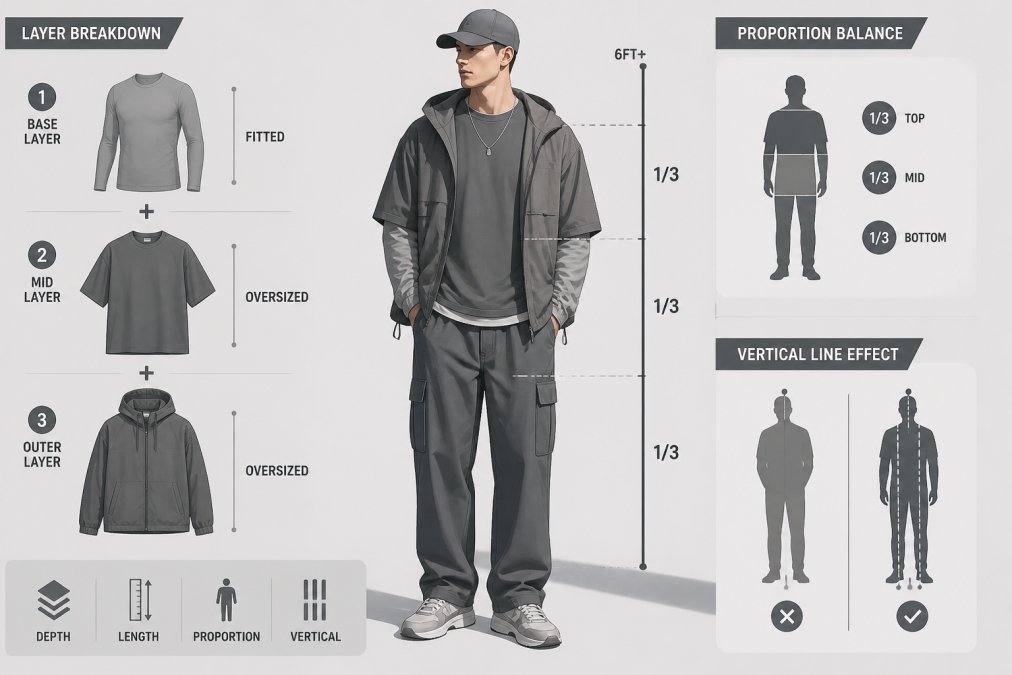
The foundation of tall-guy layering is using fitted base layers under oversized pieces. A fitted long-sleeve t-shirt under an oversized short-sleeve creates definition at the mid-section while maintaining the oversized aesthetic. This prevents the "swimming in fabric" look that happens when you layer oversized on oversized.
Create vertical lines, not horizontal ones. Horizontal lines make you look wider and shorter. Vertical lines draw the eye up and down, enhancing your height. A practical layering formula for tall guys: fitted base layer, oversized mid-layer, optional outer layer. The fitted layer anchors your proportions; the oversized mid-layer gives you the streetwear aesthetic.
Colour coordination matters more in layering than most tall guys realise. Monochromatic or analogous colour schemes create visual continuity that enhances vertical lines. Length is critical, the sweet spot for an outer layer is usually just below your hip, which creates balance without adding visual bulk.
The mistake many tall guys make is layering too many oversized pieces. Three oversized items stacked on top of each other creates a silhouette that's too wide relative to your height. Mixing fitted and oversized pieces solves this by creating definition points that break up the visual bulk.
Choosing the right streetwear sizing for tall guys comes down to understanding your actual measurements and how different brands cut their pieces. Standard sizing won't work. Oversized isn't automatically better. What matters is matching your specific inseam, torso length, sleeve length, and shoulder width to brands that account for tall proportions.
Cali Studios offers both oversized and regular fits with clear model references showing how pieces sit on 183cm frames. That transparency matters because you can see exactly how the piece will hang on your body before ordering. Start with accurate measurements, use the size chart with torso and sleeve length specifications, and choose pieces designed with proportion in mind. The fit you get will be worth the extra attention to detail.
Frequently Asked Questions
What size shirt should a tall guy wear in streetwear?
There's no single answer, it depends on your exact measurements, not just height. A 188cm man might wear large in one brand and XL in another. Always measure your inseam, sleeve length, and torso length, then compare those numbers to the brand's size chart. Streetwear brands vary wildly in how they cut drop shoulders and oversized silhouettes, so chart comparison beats guessing. Cali Studios models at 183cm wear large, but your ideal size depends on your specific proportions.
How do you measure sleeve length for tall men's streetwear?
Measure from the centre back of your neck, across your shoulder, down your arm to your wrist bone. For streetwear, add 2-5cm depending on whether you want a cropped, regular, or extended cuff look. Drop-shoulder styles sit lower, so your sleeves will appear longer, measure the actual garment's cuff length against your arm, not just the stated size. Many tall guys find standard large sleeves hit mid-forearm; you likely need XL or tall-specific sizing for proper wrist coverage.
What is the difference between standard and tall sizing in streetwear?
Standard sizing assumes proportional height-to-torso ratios. Tall sizing extends the inseam, torso length, and sometimes sleeve length without widening the shoulders. However, most streetwear brands don't offer tall variants, they only make standard and oversized. Oversized isn't the same as tall; it adds width and length. For tall frames, you often need to buy a larger standard size, then tailor the width, or find brands that specifically extend their proportions. Check the size chart's actual measurements, not just the label.
How can I prevent hoodies from shrinking and looking too short after washing?
Cotton streetwear shrinks 3-8% in the wash. For tall guys, that lost length is critical. Wash in cold water (30°C or below), use gentle cycle, and air-dry flat or on a hanger, never tumble dry. Pre-wash new pieces in cold water before wearing to set the fabric. If you're buying cotton hoodies, account for shrinkage by sizing up slightly or choosing blended fabrics (cotton-poly blends shrink less). Cali Studios pieces use quality fabrics designed to hold their shape, but proper care extends fit and longevity.
This article was written using GrandRanker
