




Table of Contents
- Plain vs Graphic Streetwear T-Shirts: The Quick Comparison
- Side-by-Side: Pros and Cons
- What Each Tee Actually Is
- Graphic T-Shirt Outfit Ideas for Streetwear
- How to Style a Plain T-Shirt Without Looking Basic
- Finding the Best T-Shirt Fit for Men
- Print Durability, Fabric and Care
- Cost-Per-Wear and Value: Which Tee Earns Its Place?
- Conclusion: Building a Wardrobe That Uses Both
- Frequently Asked Questions
Last Updated: October 21, 2026
Plain vs Graphic Streetwear T-Shirts: The Quick Comparison
Plain vs graphic streetwear t-shirts comes down to one question: do you want the shirt to do the talking, or the rest of the outfit? At Cali Studios, we build both, and we have a clear view.
Below, we break down the pros and cons of each, show you how to style both, and explain where the money actually goes.
Side-by-Side: Pros and Cons
Neither style wins outright. The right pick depends on how you dress and what you already own.
| Factor | Plain Tee | Graphic Tee |
|---|---|---|
| Versatility | Works with almost anything | Needs the rest of the outfit kept simple |
| Personality | Neutral, understated | Immediate personal expression |
| Styling effort | Low | Higher, needs coordination |
| Layering | Excellent under jackets and overshirts | Can clash under busy layers |
| Longevity of look | Timeless | Tied to the design and trend |
| Best for | Building a base wardrobe | Making a statement piece |
Plain tee pros: endless mix and match, forgiving on fit, easy to layer, never dates. Plain tee cons: can read as basic if the fit and fabric are poor, and adds little visual impact alone.
Graphic tee pros: instant personality, a natural focal point, strong in streetwear styling. Graphic tee cons: harder to coordinate, print quality matters more, and a weak design drags the whole outfit down.
What Each Tee Actually Is
A plain tee is an unprinted T-shirt where fabric, fit and colour do all the work. A graphic tee carries a print, whether that is an illustrated design, a slogan tee or a band tee, and the print becomes the visual anchor of the outfit.
The Plain Tee as a Clean Base
The plain tee is the wardrobe staple that holds a rotation together. Because there is no print competing for attention, the eye goes to your trousers, your trainers and your outerwear. That makes it the most useful piece in a streetwear wardrobe for layering, and the safest choice when you want a clean look. Fit and fabric carry it entirely, so a plain tee with a poor drape or a sagging collar has nowhere to hide.
The Graphic Tee as a Statement Piece
The graphic tee is wearable art, and it works best when you treat it that way: one bold piece, everything else quiet. This is where personal expression lives in streetwear, and it is why graphic tees carry so much of the culture.
Graphic T-Shirt Outfit Ideas for Streetwear
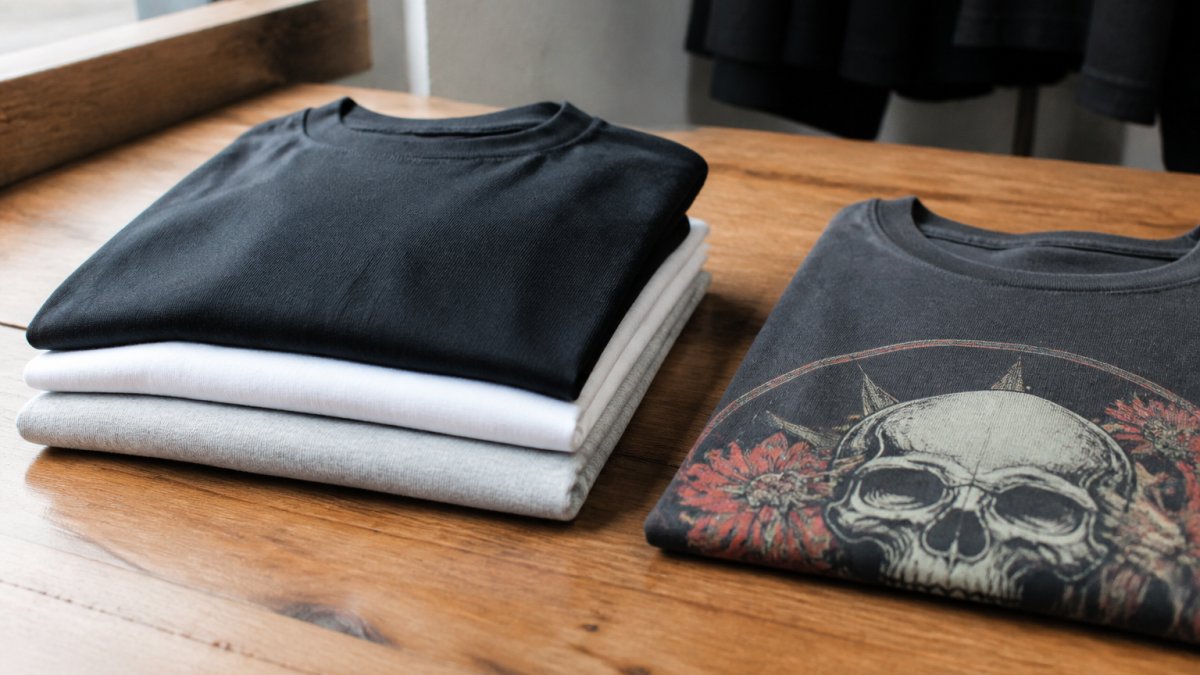
Graphic t-shirt outfit ideas work best when the tee is the only loud element. Keep the trousers, shoes and outerwear muted and let the print lead. The difference between a look that reads intentional and one that reads cluttered usually comes down to three things: print scale, print placement and colour coordination.
Print scale and placement
A large front print pulls attention to the chest and shortens the torso visually, so it works best on a boxy or oversized tee where the volume balances the graphic.
Placement also affects proportion. A centred chest print draws the eye inward and can make narrow shoulders look narrower; a print that sits higher and wider across the chest broadens the upper body.
Colour coordination
Treat the print as your colour anchor. Pick one colour from the graphic and repeat it once elsewhere in the outfit, a cap, a sock stripe, a trainer accent or a bag, and keep everything else neutral. Two or three colours in total is a reliable limit. If the print is multicoloured, keep the rest of the outfit black, white, grey or navy so the tee does the talking.
Four outfits that work, and why
- Oversized graphic tee, loose cargo trousers, chunky trainers. The classic streetwear silhouette: volume on top, volume below, heavy footwear to ground it. Works because the oversized fit balances a large front print and the cargo pockets add texture without adding competing graphics.
- Faded graphic tee, straight-leg dark denim, low-profile sneakers. Tighter and cleaner, good for everyday wear. The faded print reads softer, so the outfit can afford a slightly neater silhouette; dark denim keeps the focus on the tee.
- Graphic tee under an open overshirt, relaxed joggers, cap. Layering adds depth without hiding the print. Choose an overshirt in a solid neutral so the graphic remains the focal point, and repeat one print colour in the cap.
The mistake we see most is stacking a graphic tee with printed trousers or a busy jacket. Pick one focal point. If the tee is loud, everything else stays quiet.
How to Style a Plain T-Shirt Without Looking Basic
How to style a plain t-shirt comes down to fit, layering and colour. A plain tee looks basic when it is the wrong size or the only thought in the outfit.
Start with the shoulders: the seam should sit at or just past the edge of your shoulder for a regular fit, further out for an oversized fit. Tuck the front slightly into trousers to define the waist.
Finding the Best T-Shirt Fit for Men
The best t-shirt fit for men depends on the silhouette you want, not on a single correct size. Regular fit sits close to the body with a clean line. Oversized fit drops the shoulder and adds room through the chest and body. Boxy fit is shorter and wider, with a straight hem. But knowing the definitions is only half the job, the useful question is which fit suits your body, your layering habits and the look you are building.
A practical decision framework
Use these four questions to narrow the choice before you look at prints:
- What is the tee for? For everyday wear and smarter casual outfits, a regular fit is the safest base. For streetwear styling and layering, an oversized or boxy fit gives the volume the look needs.
- Will you layer it? If the tee sits under a jacket, overshirt or hoodie, an oversized fit can bunch at the hem and sleeves. A regular fit layers more cleanly; a boxy fit works under open layers but not under close-fitting ones.
- What is your frame? A regular fit flatters most body types because it follows the body without clinging. An oversized fit adds visual width, which suits narrower frames and can overwhelm broader ones if the drop is too extreme. Boxy fits shorten the torso, so they work best on average-to-taller frames or when worn with higher-rise trousers.
- How do you want the outfit to read? Clean and understated points to regular; relaxed and current points to oversized; fashion-forward and cropped points to boxy.
Checking the details before you buy
Fit changes how a tee reads, so check three things before you buy: shoulder seam position, sleeve length (mid-bicep is a good guide) and body length (it should cover your waistband without bunching).
If you are between sizes and want the oversized look, size up. Our US Seal T-shirt runs oversized with a dropped shoulder, and our Tiger Ringer T-Shirt is a regular fit, so you can pick the silhouette first and the print second.

Print Durability, Fabric and Care
Print durability and fabric decide whether a tee still looks good after twenty washes. Screen printing, the most common method for streetwear graphics, holds up well when the shirt is washed cold and inside out.
Fabric weight matters too. Hand-distressed details and raw edge hems, like those on our Eagle T-shirt, are designed to age, so treat them as part of the look rather than a fault.

Cost-Per-Wear and Value: Which Tee Earns Its Place?
Cost-per-wear is the honest way to compare the two. A plain tee gets worn with everything, so its cost-per-wear drops fast. A graphic tee gets worn less often but does more work per wear, because it carries the outfit.
Take a £40 tee. Worn twice a week for a year, that is roughly 100 wears, or about 40p per wear. Value comes from fabric weight, fit and print quality, not from the label.
Conclusion: Building a Wardrobe That Uses Both
The plain vs graphic streetwear t-shirts debate has a simple answer: you need both, in the right ratio. Build the base with plain tees in neutral colours and a fit you trust, then add graphic tees as statement pieces that carry a look.
At Cali Studios, we make both sides of that wardrobe in oversized and regular fits, from the hand-distressed Eagle T-shirt to the 200GSM US Seal T-shirt and the regular-fit Tiger Ringer.

Frequently Asked Questions
What is the difference between a plain and a graphic T-shirt?
A plain tee carries no print, so it works as a neutral base that lets trousers, jackets and trainers take the lead. A graphic tee has a design, slogan or illustration on the chest or back, which makes it the focal point of the outfit. In streetwear, plain tees tend to suit layering under overshirts and hoodies, while graphic tees carry a look on their own. The plain vs graphic choice usually comes down to whether you want the outfit to have one loud element or several quieter ones.
Are plain T-shirts easier to style than graphic T-shirts?
Plain tees are more forgiving because they clash with nothing. You can pair a white or black plain tee with any trouser colour, any jacket and any trainer without thinking about matching artwork. Graphic tees need a little more coordination: the print colour should echo something else in the outfit, and the graphic size should suit your frame. That said, a graphic tee does more work on its own, so a single graphic plus plain bottoms is often faster to put together than a fully plain outfit that needs layering to feel finished.
How do you style a graphic T-shirt for a streetwear outfit?
Let the print lead and keep everything else quiet. Pick one colour from the graphic and repeat it in your trousers, cap or trainers. Go oversized on the tee with a boxy or dropped-shoulder cut, then balance the volume with a straighter leg below. Layer an open overshirt or hoodie over the top so the print sits in a frame rather than covering your whole torso. Avoid stacking a second loud print in the same outfit, and keep the graphic at chest or back scale rather than a small centred logo.
Can a plain T-shirt make a streetwear outfit look good?
Yes, and often better than a graphic. Streetwear silhouettes do most of the work: an oversized fit, a dropped shoulder, heavyweight cotton and a wide ribbed collar read as deliberate even with no print. Pair a plain 200GSM organic cotton tee with baggy cargos, a zip hoodie and chunky trainers and the outfit looks considered, not empty. Plain tees also let a statement jacket or a distinctive pair of trainers be the focal point. The risk is a thin, tight plain tee, which reads as underwear rather than streetwear.
Which is better value, a plain or a graphic T-shirt?
Graphic tees usually cost more than plain ones at the same quality level because of the printing process, and the print is the part that ages first. A plain tee at £40 worn twice a week for two years works out at well under £1 per wear and stays presentable throughout. A graphic tee at the same price gives you the same cost-per-wear maths but a shorter useful life if the print cracks. The practical answer is to buy plain tees as your base layer in numbers, and spend on one or two graphics you genuinely want to wear repeatedly.
