




Last Updated: November 17, 2026
Quick Summary
To prevent skate shoe heel wear, fix the two causes separately: tighten the heel lock with the top eyelets so your foot stops sliding inside the shoe, and change your contact points so your heel stops dragging on grip tape during setup, pop and landing. Patch small worn spots early and rotate two or three pairs so each one dries fully.
- A hole in the inside heel lining means a loose fit or heel slippage, not bad materials.
- Keep your heel off the tape during setup by resting on the ball of your foot and arch.
- Land with your weight over the balls of your feet so your heels do not drag on impact.
- Round the corners of a heel patch, since square corners peel up first.
- Use a flexible footwear contact adhesive, not superglue, which sets hard and cracks.
Table of Contents
- Skate Shoe Heel Wear Causes: Why the Heel Goes First
- How to Stop Heel Drag Skateboarding
- Choosing Durable Skate Shoes: Uppers, Outsoles and Grip Tape
- Fit, Lacing and How You Put Your Shoes On
- Fitting a Skate Shoe Heel Patch Before Damage Spreads
- The Best Glue for Skate Shoe Repairs and How to Apply It
- Repair or Replace? Deciding When Worn Heels End a Shoe's Life
- Build a Rotation That Keeps Your Kicks Skatable
- Frequently Asked Questions
Skate Shoe Heel Wear Causes: Why the Heel Goes First
Your heel moves the most: every kickflip, push and landing drags it against the board or the shoe's lining. Most guides say buy suede and stop there, which misses the real cause.
Watch out: the biggest mistake is blaming the shoe. A cheap shoe wears faster, but a well-made shoe with a loose heel fit will still rub through in weeks.
Inside Lining Wear Versus External Heel Wear
These are two different problems needing two different fixes.
Inside lining wear happens when your heel slides up and down inside the shoe, rubbing the fabric against your sock until a hole appears at the back.
External heel wear happens when the outside of the heel contacts grip tape during tricks.
Check the inside of your shoes now. A hole in the lining means you need a better fit.
How to Read Your Wear Pattern
Your wear pattern tells you exactly what to fix. Use this as a quick diagnostic:
- Hole in the inside heel lining → loose fit or heel slippage
- Worn outer heel corner → heel drag during tricks
- Both heels worn evenly → technique and fit both need work
Read the pattern before you buy anything. A patch on a shoe with a bad fit will just peel off again.
How to Stop Heel Drag Skateboarding
Heel drag is the biggest cause of external skate shoe heel wear and the most misunderstood. Most skaters picture a heel scraping the ground, but in skating the drag is usually against grip tape: your heel brushes the board during setup, pop, catch or landing, and the abrasive grit acts like sandpaper on the heel counter and outer heel corner.
The mechanism matters because it tells you what to change. Heel drag is a contact problem, not a materials problem. A tougher shoe delays the damage; a cleaner movement pattern prevents it.
Diagnose the drag before you fix it
Look at where the outer heel is worn:
- Worn outer heel corner on the back foot → your back heel is catching the tape during pop or catch, common with heelflips and tricks where the back foot rolls outward.
- Worn outer heel on the front foot → your front heel is dragging during setup or landing, often because your foot sits too far back on the board.
- Wear along the heel seam rather than a patch → the shoe is flexing and rubbing against the tape repeatedly, usually from a loose fit combined with a wide stance.
Skaters often blame the shoe when wear is concentrated on one corner. That corner is a contact point, and contact points can be moved.
Change the contact, not just the shoe
These fixes target the mechanism rather than the symptom:
- Keep your heel off the tape during setup. Rest the ball of your foot and the arch, not the whole foot; a heel that sits flat on the board is a heel that drags.
- Land with your weight forward. Landing back on your heels drags them across the tape on impact; aim to land over the balls of your feet and let your knees absorb the load.
- Check foot position before every trick. A heel that creeps back during a session will drag on the next pop, so reset your stance deliberately.
Watch out: do not simply skate less aggressively to save shoes. The wear comes from contact points, and contact points can be adjusted without dulling your skating.
The Skateboard GB safety and setup guidance is a useful starting point if you are new to board setup and want to get the basics right.
Where the outer heel wears tells you which contact point to change.
| Wear location | Likely cause | Fix |
|---|---|---|
| Worn outer heel corner on back foot | Back heel catching tape during pop or catch | Keep heel off tape during setup |
| Worn outer heel on front foot | Front heel dragging during setup or landing | Reset foot position before every trick |
| Wear along the heel seam | Shoe flexing against tape from loose fit | Tighten the heel lock with top eyelets |
| Wear on one shoe only | Uneven stance or foot position | Check which foot you favour |
Choosing Durable Skate Shoes: Uppers, Outsoles and Grip Tape
Durable skate shoes come down to three things: the upper material, the outsole, and how the shoe handles grip tape abrasion. Get these right and you start with a shoe that resists heel wear from day one.
Suede versus canvas uppers.
Outsole.
Grip tape abrasiveness. Coarse, fresh grip tape eats shoes. Rubber grip tape is softer on uppers and heels. If you are replacing tape anyway, this is an easy win.
For a deeper look at the mistakes that speed up wear, read our guide to 7 grip tape mistakes that ruin your skate shoes. And if you are weighing up construction across the whole outfit, our piece on the essential features of professional skate clothing covers what actually lasts.
Fit, Lacing and How You Put Your Shoes On
A well-fitted skate shoe is the best defence against inside heel lining wear. If your heel moves inside the shoe, the lining will rub through no matter how good the shoe is.
Heel slippage is the enemy here. Fix the fit and you fix most lining wear.
- Leave a thumb's width at the toe. Too much room and your foot slides forward and back.
- Lock the heel with the top eyelets. Use a heel-lock lacing pattern to hold the foot in place.
- Wear the right socks. Thin socks let the foot slide. Durable skate socks add cushioning and reduce friction. If you are unsure whether they are worth it, our guide on durable skate socks for high impact breaks it down.
A common mistake is tying laces tight everywhere. That squeezes the middle of the foot but leaves the heel loose. Tighten at the top, not the middle.
Fitting a Skate Shoe Heel Patch Before Damage Spreads
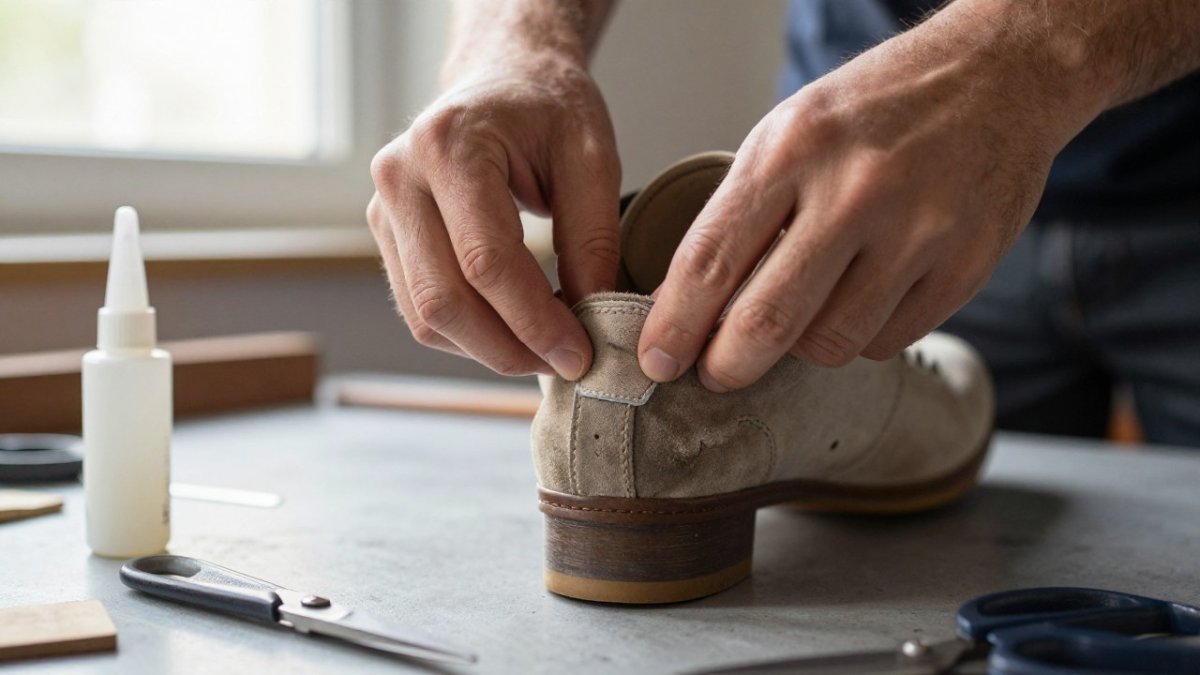
A skate shoe heel patch stops a small worn spot from becoming a hole. Fit it early and you can add months to a shoe's life; the difference between a patch that holds and one that peels in a session is almost always preparation, not the patch itself.
Choose the right patch material
- Suede patches work well inside the heel lining. Suede is soft against the sock, resists abrasion and flexes with the shoe.
- Rubber patches suit the outer heel where grip tape does the damage. Rubber is tougher against grit but stiffer, so keep it to flat or gently curved areas.
- Offcuts from an old shoe are a practical free option if the material is still sound. Avoid using worn-out material that is already thinning.
A patch that is too thick will lift at the edges; one that is too thin will wear through quickly. Match the patch thickness to the area you are repairing.
Step-by-step fitting
- Clean the area properly. Wipe the worn spot with a damp cloth and let it dry fully. For a greasy or glue-contaminated heel, mild soap and water is enough; rinse and dry completely, since adhesive will not bond to dirt, moisture or old glue.
- Cut the patch to size. Use a suede or rubber patch slightly larger than the worn area so the edges sit on sound material.
- Round the corners. Square corners peel up first; rounded edges stay put because there is no sharp corner for the sock or tape to catch.
- Dry-fit before gluing. Hold the patch in place and check that it sits flat and does not bunch when the shoe flexes. Trim again if needed.
- Apply shoe adhesive to both surfaces. Spread a thin, even layer on the patch and the shoe, and let both go tacky before joining, most footwear contact adhesives need a short open time rather than an immediate bond.
- Press firmly for a minute. Hold it in place, working from the centre outwards to push out air bubbles.
- Let it cure fully. Leave the shoe overnight before skating; a patch skated too soon will shift and peel.
- Check it after a session. Re-press any lifted edges before they spread, and re-glue early rather than waiting for the patch to fail.
Watch out: do not glue a patch over a wet, dirty or still-worn heel. It will peel within a session, and you will have wasted the patch and the glue.
Safety when working with adhesive
Use footwear adhesive in a ventilated space and keep it off your skin. Follow the manufacturer's instructions for open time and cure time, and store it sealed so it does not dry out between repairs.
The Best Glue for Skate Shoe Repairs and How to Apply It
The best glue for skate shoe repairs is a flexible shoe adhesive made for footwear, not superglue. Superglue sets hard and brittle, and it cracks the moment the shoe flexes.
Look for a contact adhesive or dedicated shoe repair glue. These stay slightly flexible, which is exactly what a heel needs.
How to apply it:
- Clean and dry both surfaces first. Glue will not bond to dirt or moisture.
- Apply to both sides. Coat the patch and the shoe, then wait until both are tacky.
- Press and hold. Firm pressure for a minute sets the bond.
Repair or Replace? Deciding When Worn Heels End a Shoe's Life
Repair makes sense when the damage is contained to the heel. Replace when the damage has spread past it.
Ask yourself these questions:
- Is the wear only in the heel lining or outer heel?
- Is the outsole still intact?
- Is the upper still holding together at the seams?
If you answered yes to all four, repair it. A patch and some glue will get you more sessions.
If the outsole is worn through, the seams are splitting, or the shoe no longer fits right, it is time to replace.
The same logic applies to the rest of your kit. When your trousers wear out, weigh up skateboarding pants versus jeans for mobility before you buy again.
Build a Rotation That Keeps Your Kicks Skatable
A rotation is the simplest long-term fix for skate shoe heel wear.
Rotating also lets each pair dry out fully between sessions.
Here is how to build a rotation that works:
- Keep one pair for skating, one for everyday wear. Your skate pair takes the abuse; your everyday pair stays sharp.
- Let each pair dry for a full day before wearing it again.
- Clean and check heels after every few sessions. Catch wear early.
For pieces to build that rotation around, our guide to durable streetwear for daily skating covers the essentials that hold up.
Skate shoe heel wear is fixable, but only if you deal with the cause, not just the symptom.
Frequently Asked Questions
Why do skate shoes wear through at the heel?
Two forces do the damage. Externally, grip tape scrapes the heel when you drag your foot to set up for a trick, and ollies scuff the heel side. Internally, heel slippage grinds the lining against your sock every step. Loose lacing and a roomy fit make that internal rubbing worse, so the lining goes thin and splits long before the outsole is finished.
How can I stop the inside heel of my skate shoes wearing out?
Lock the heel down. Lace through the top eyelets properly, use a heel-lock lacing pattern, and size down half a size if your heel lifts when you walk. Fit a suede or rubber heel patch early, before the lining splits, and always undo your laces when putting shoes on so you are not crushing the counter. Rotating two pairs also gives the lining time to dry and recover between sessions.
Can heel patches or shoe glue prevent skate shoe wear?
They slow it down rather than stop it. A skate shoe heel patch adds a sacrificial layer of suede or rubber that takes the friction instead of the lining. Glue holds a patch in place and reattaches peeling seams, but it will not rebuild missing lining. Patch early, when you first see a worn spot, and you can add months of wear before a replacement is needed.
How often should I replace skate shoes with worn heels?
Replace when the outsole is thin under the ball of the foot, the midsole has compressed, or a patch will not hold. A split lining or scuffed heel counter on its own is not a reason to bin a pair: patch it and keep skating. If the heel is gone and the sole is smooth, the shoe has done its job and it is time for a new pair.

